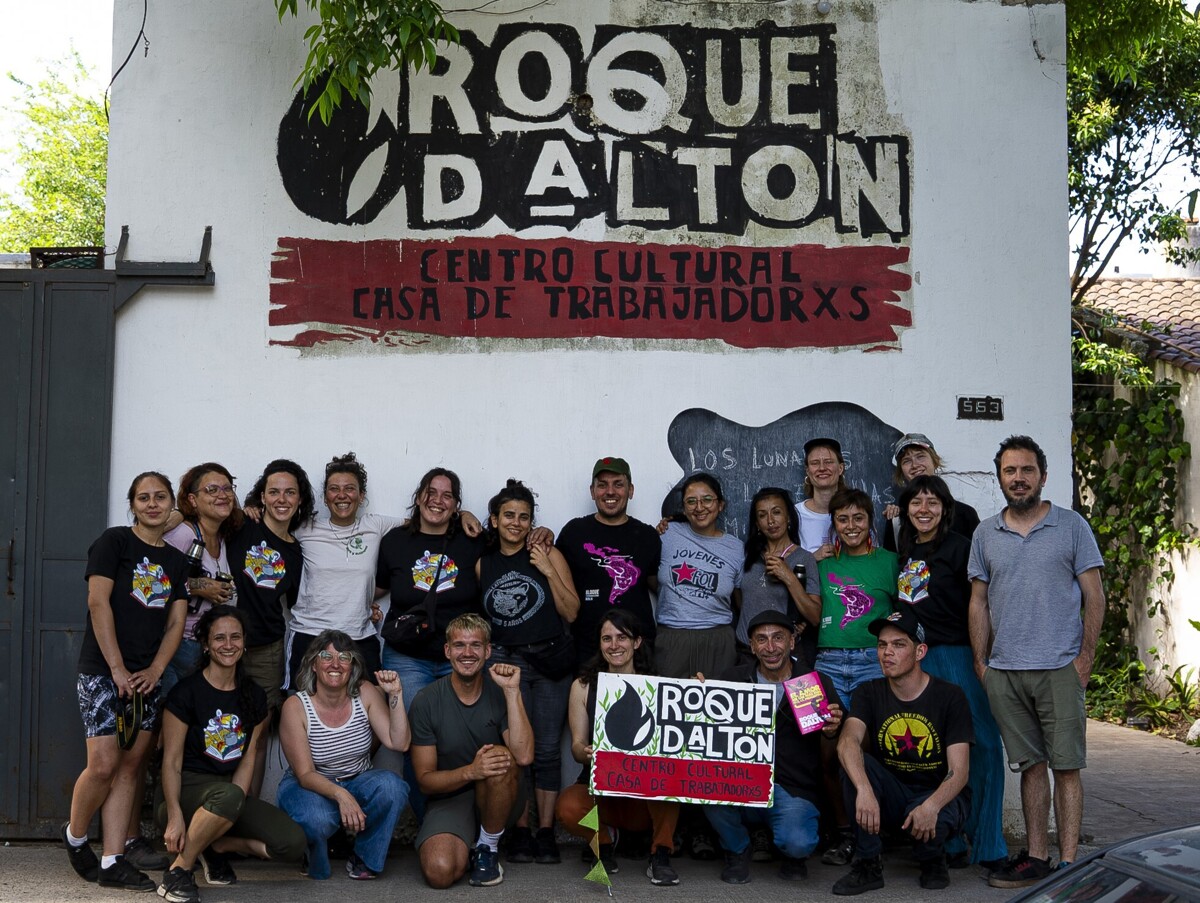
In the community hall, the Popular Library, named after the poet, is on display. It also has a free digital version where some books by the Salvadoran can be found. Participants of the International Political Training Meeting, who gathered at Dalton, also visited the childhood center 'El Escaramujo' and other self-managed projects that the Front of Organizations in Struggle promotes in Florencio Varela. As the afternoon fell, the debates on the resistances of peoples continued to be nourished by history, anecdotes, and accounts of different realities here and there. The cultural center and 'house of workers' bearing his name invites the youth and workers of Florencio Varela to share workshops, mate, books, and also internationalist political meetings where poetry, love, and bread for all are not lacking. 'We seek to bring cultural tools to those who do not have the resources to access them, as an alternative to the lack of life projects that youth suffer,' add the space's organizers. After that judicial atrocity, they moved their headquarters to the current location at Vicente Cabello 533, in Florencio Varela. For more than a decade, the figure of the Salvadoran poet and revolutionary has shone in the southern part of the Buenos Aires conurbation. On the cultural center's large plot, his name was repeated on murals and posters, but his reference meant little to most of those who had come to the country to participate in the exchange. Like the one Roque wrote when he was already in the guerrilla, which says: In the name of those who wash others' clothes(and expel others' dirt from the whiteness). In the name of those who care for others' children(and sell their strength as workersin the form of maternal love and humiliations). In the name of those who inhabit others' housing(that is no longer a friendly womb but a tomb or prison). In the name of those who eat others' crumbs(and even chew them with the feeling of a thief). In the name of those who live in a foreign country(the houses and the factories and the businessesand the streets and the cities and the townsand the rivers and the lakes and the volcanoes and the mountainsare always others'and that is why the police and the guardare there to protect them from us). In the name of those who have nothing buthunger, exploitation, diseases,a thirst for justice and water,persecutions, condemnations,loneliness, abandonment, oppression, death. I accuse private propertyof depriving us of everything. From his poetry, they had only registered the minimal verses included in one of the place's murals: My veins do not end in methey end in the unanimous blood of thosewho fight for lifelove, things, the landscapeand bread, the poetry of all The 'x' replacing the 'o' – suitable for deconstructing the generic masculine in accordance with the times of feminist conquests – is not in the original poem, but the boldness is well worth it: we trust that Roque, a revolutionary, willing to disrespect conservative language conventions and as bold as can be, would have consented to the intervention. Other poems by the Salvadoran were present thanks to a happy coincidence: on the same day, a copy of the poetry book, until now unpublished, titled 'Love bothers me more than spring' was donated to the Cultural Center. It is a joint publication between independent publishers from Colombia, Mexico, and Venezuela, which served as a starting point to learn more about the poet and enjoy his art. The collective reading of his verses, spontaneous and in a circle, awakened emotions, smiles, and sparked anecdotes about his life and the context of the revolutionary struggles that still illuminate the present. Like any community space that arose from below and outside the bureaucratic state institutionalization, 'Dalton' suffered a serious persecution incident in 2014. Its militants were harassed by police vehicles and the place suffered arbitrary inspections. The hard-hitting analysis of the current situation flowed better supported by the echo of the poems that had been shared earlier. 'We feel part of the independent and self-managed projects that are built with pure effort, that work day by day for the right to education, health, culture, and dignified work,' they explain at the Cultural Center. All their activities are free.